Repairs that are usually DIY-safe
These jobs share a pattern: they're above ground, they don't carry the fence's structure, and if you get one wrong you can redo it for the price of a board.
- Replacing pickets and boards. The friendliest wood fence repair there is. Pry off the damaged picket, cut the new one to length, screw it on. Match the profile and let fresh pressure-treated wood weather a bit before staining.
- Swapping one pre-built panel. On post-and-panel fences, one storm-damaged panel can usually be unscrewed and replaced in an afternoon, as long as both posts are sound.
- Gate hardware fixes. Tightening or replacing hinges, re-aligning a latch, adding a diagonal brace or an anti-sag kit to a dragging gate. Most "gate problems" are hardware problems.
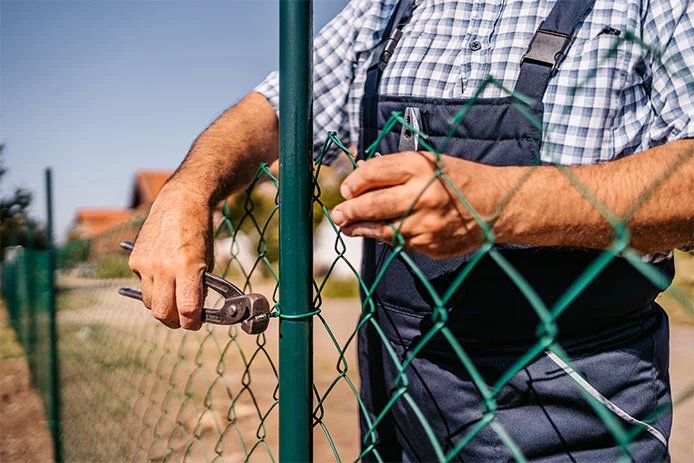
- Chain-link patching. Weaving in a patch of fabric, re-tying ties, replacing a tension bar or a few rail caps. Fiddly, not difficult.
- Vinyl crack kits — small damage only. Hairline cracks and small holes can be filled with a vinyl repair kit. Large cracks mean a panel swap (below).
- Re-setting one leaning post. Moderate DIY: heavy, dirty, and completely doable. Full instructions in our leaning fence guide.
- Cleaning, staining and sealing. Pure maintenance, and the best money you'll ever spend on a wood fence's lifespan.
Repairs to hand to a professional
- Multiple structural posts or a whole run. When several posts fail together, the run usually needs to be rebuilt to a line — posts at consistent depth, on a string, at the right spacing. Pros do this fast and warranty it; DIYers tend to inherit the same failure in two years.
- Long runs and tall fences. Anything over about 6 feet, or long straight runs where a small alignment error compounds panel after panel.
- Vinyl and aluminum section replacement. Interlocking systems need exact-match parts and careful handling; a forced fit cracks the neighboring panel and doubles the job.
- Retaining-wall and slope fences. If the ground itself is moving, the fence is a symptom. Fix the cause first — that's engineering territory.
- Shared boundary fences. Where cost-sharing or the property line is even slightly in question, a pro's contract and paperwork protect you in ways a handshake doesn't.
- Anything with permits, HOA rules or pool codes. Pool fencing in particular has strict height, latch and spacing codes in most jurisdictions. A pro knows the local rules; a failed inspection is an expensive teacher.
- Damage near utilities or trees with protected roots. Digging constraints change the job. Let someone insured do it.
Go DIY when…
- The damage is one panel, one post, or one gate
- The posts pass the screwdriver test
- You already own a drill, level and shovel
- The fence is entirely on your property
- No permit or HOA approval is involved
Hire a pro when…
- Three or more posts have failed
- More than ~20% of the fence is damaged
- It's vinyl/aluminum needing matched parts
- A boundary, HOA, permit or pool code applies
- The ground is moving, not just the fence
Compare DIY materials against a real quote
Our cost guide shows both sides of the ledger — what pros charge, and what the same jobs cost in materials alone.
The middle option: a handyman
For one-panel, one-post and gate jobs that you'd rather not do yourself, a licensed handyman is often cheaper than a fencing company — fencing firms price in their specialization, and many have minimum job fees that make small repairs expensive. For anything structural, multi-post, or under warranty expectations, go with the fencing company. Either way, verify insurance (see the hiring guide).
What DIY really costs (and what it saves)
DIY fence repair is mostly a labor swap. Replacing a post yourself: roughly $25–$75 in materials (post, concrete, gravel, screws) versus $150–$350 professionally done. Replacing pickets: a few dollars each plus your time, versus a $150+ service call. The savings are real — but price your weekend honestly, include tool rental if you need a post-hole digger or a demo hammer, and remember a pro's work usually comes with a workmanship warranty. The honest breakeven point for most homeowners: DIY wins on small, above-ground jobs; pros win as soon as concrete, alignment and multiple posts stack up.
DIY safety notes that actually matter
- Call 811 before any digging — every time, even for one post hole.
- Panels are heavier and more awkward than they look. Work with a helper on full panels and gates; a falling 6×8 panel can genuinely injure.
- Watch for hidden fasteners when prying or sawing old wood — and assume old fences may contain nails exactly where your saw wants to go.
- Gloves and eye protection for demo work: splinters, rusty nails and concrete dust are the everyday hazards, not the dramatic ones.
- Concrete is caustic. Gloves on, sleeves down, and rinse skin that contacts wet mix.
The deciding question
If you had to name it, most fence repairs come down to one question: is the structure (posts and line) sound? Sound structure plus surface damage is DIY country. Failed structure — or rules, boundaries and codes layered on top — is where a good pro is worth every dollar. And when you go that route, do it properly: here's how to find a good fence repair company near you.