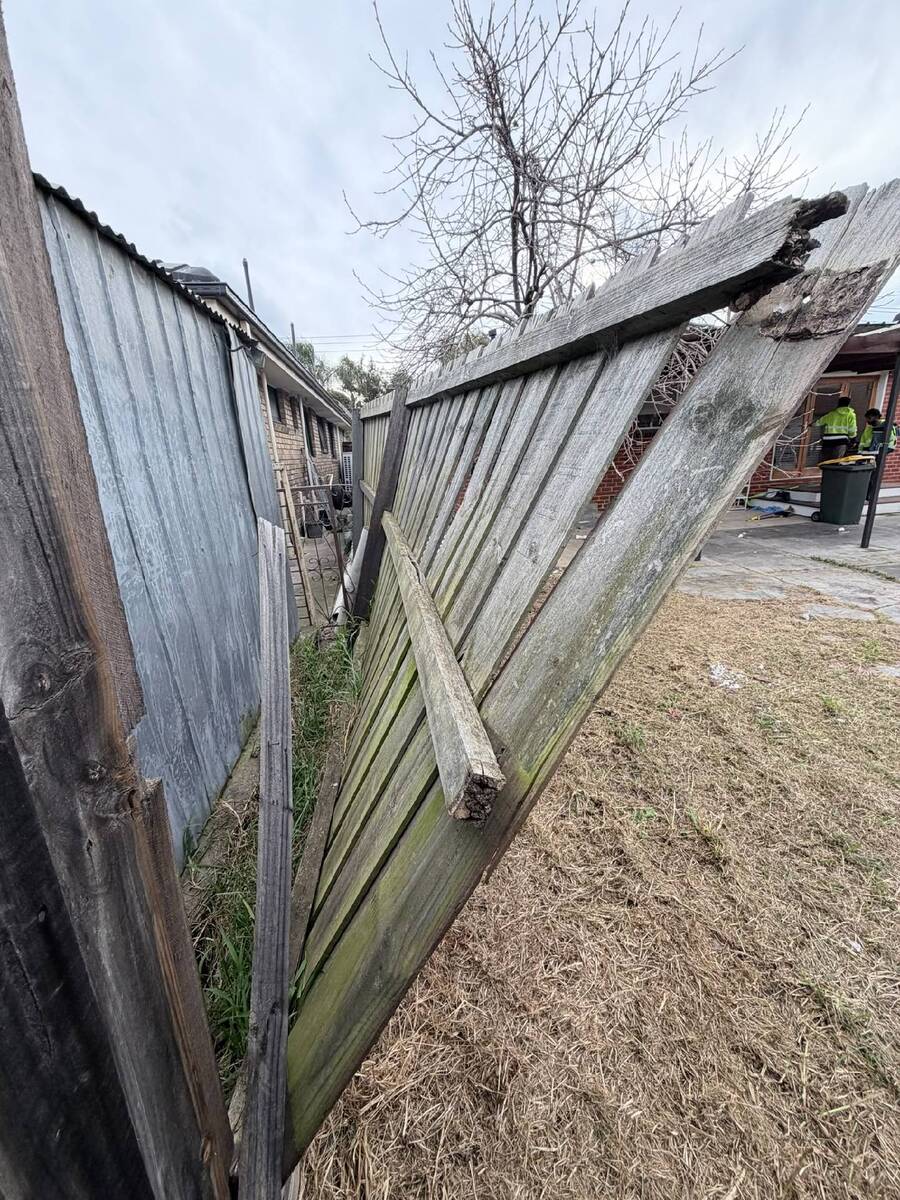
First: make the fence safe
Before any repair thinking, walk the damage with a safety eye — and wait until the storm has fully passed. Storm-damaged fences hide the hazards that actually hurt people:
- Downed or sagging wires anywhere near the fence: treat them as live. Don't touch them, don't touch a fence touching them, keep people and pets well back, and call your power company or emergency services. A metal fence conducts; a wet wood fence is not the insulator you want to test.
- Leaning trees and hung-up limbs ("widowmakers") overhanging the fence are tree-crew work, not fence work. Never cut or pull a limb that's resting on a fence under load.
- Unstable panels can fall. A section hanging by one rail can drop in the next gust. Approach from the uphill, upwind side, and keep kids and dogs out of the fall zone until it's braced or down.
- Watch your footing. Saturated soil, hidden debris and exposed nail points in fallen panels are the everyday injuries. Boots and gloves, not sandals.
Assess the whole fence, not just the fallen part
Walk the entire line, not only where it fell, and sort every section into four buckets:
- Down: panels on the ground, posts snapped or pulled out.
- Leaning: still standing but out of plumb — almost always a post footing that let go in wet soil.
- Holed or cracked: upright, but with impact damage from branches or flying debris.
- Standing but stressed: looks fine, sways more than it should. Push each post at the top and screwdriver-test any post in the damaged area at ground level — storms finish off posts that rot had already weakened, and the neighbor of a failed post took the same wind. The diagnosis method is in our leaning fence guide.
Then count. If the damage totals more than about 20% of the fence — posts, panels and pickets together — you're at the repair-vs-replace threshold, and it's worth pricing a replacement run alongside the repairs (see the cost guide). Below that, repair wins easily.
Document the damage before you touch anything
If there's any chance of an insurance claim, your phone is the most important tool of the day — and it has to come out before the pry bar does:
- Wide shots first: photograph each damaged section from several feet back, from both sides, so the extent of the damage is unmistakable. Then close-ups of snapped posts, split rails and impact points.
- One slow video walk of the whole fence line, narrating what you're seeing, ties the stills together and dates the record.
- Photograph the cause, not just the result: the fallen tree or limb, the flooded footing, the debris that struck the panel.
- Keep every receipt — temporary fencing, lumber, hardware, disposal fees — and note dates and hours if you do the work yourself.
- Don't discard damaged material until the claim is settled or your insurer says otherwise; adjusters sometimes want to see it.
Why this matters: fences are typically covered under a standard homeowners policy as "other structures" when the damage comes from a covered event like wind or a fallen tree — minus your deductible. Wear, rot and age are not covered, which is exactly why photos that show storm damage (and not pre-existing rot) carry the claim. For a small repair, the deductible usually makes claiming pointless; for a storm-flattened run, it's well worth the call.
Temporary fixes that hold the line
With safety handled and photos taken, stabilize the fence so the yard is secure and no more damage happens while you wait on parts, weather or an adjuster:
- Brace leaning sections with a diagonal 2×4 screwed to a sound rail or healthy post and staked into firm ground, so the next gust doesn't finish them.
- Re-hang intact fallen panels temporarily with a few screws into the posts they fell from — enough to close the yard, with the understanding that this is a placeholder, not the repair.
- Close the gaps that matter most. Pets, small children and pools come first: a pool barrier that's down is a safety and code problem, not just an eyesore, and it should be restored — even temporarily — the same day.
- Don't "temporarily" nail into rotted posts and call it done. Screws into soft wood hold until the next windy night.
The repair order: posts, rails, panels, gates
Permanent repairs go in structural order, or you'll do them twice:
-
Posts first
Re-set posts that are sound but loose, and replace posts that snapped or fail the screwdriver test — the full method is in our rotted post guide and leaning fence guide. Every panel re-hung on a failed post is a panel that falls again, so nothing goes back up until the posts are plumb, braced and cured.
-
Rails second
Replace split, cracked or pulled-loose rails between the restored posts. Check the rails on the "standing but stressed" sections too — a rail torn half off its fasteners is next storm's failure.
-
Panels and pickets third
Re-hang salvaged panels that are genuinely undamaged, and replace the ones that aren't — measuring, fitting and fastening are covered step by step in our fence panel replacement guide. Individual broken pickets on a wood fence are a quick swap.
-
Gates last
Gates take the worst wind load and their posts may have been quietly twisted by it. Once the run is solid, check the gate's swing and latch; storm-twisted gates follow the same diagnosis as our sagging gate guide.
Re-digging posts? Call 811 again
Storm repairs that involve digging out footings or setting new posts carry the same rule as any fence digging: in the US, call 811 at least a few business days before you dig. Old utility marks from a previous project expire, and emergency conditions don't change where the gas line is.
Storm jobs are where quotes scatter most
Post-storm demand spikes prices and attracts door-to-door pressure pitches. Here's how to get comparable written quotes — and the red flags to walk away from.
When storm damage is a pro job
- A tree is on the fence, or limbs are hung up over it — tree crew first, fence second.
- The whole run is down, or damage passes the ~20% threshold where replacement pricing belongs on the table.
- Several posts failed together — the run needs rebuilding to a line, not spot fixes (see DIY or hire a pro?).
- The fence is on a shared boundary and cost-sharing or the property line needs paperwork, not just repairs.
- Anything electrical is involved — a damaged service drop, a fence tangled with wires, a gate opener with storm damage.
Before the next storm
- Probe the posts every spring. Most "storm damage" is rot damage that a storm revealed. The screwdriver test in the seasonal maintenance checklist finds the weak posts while they're still a $150–$350 repair.
- Trim limbs back from the fence line, and have dead or leaning trees assessed before they choose their own moment.
- Fix drainage that soaks footings — downspouts discharging at the fence line soften the soil that holds your posts.
- Screws beat nails for rails and panels: screwed connections survive wind racking that pops nailed ones. When you repair, upgrade the fasteners you touch.
Storm damage questions, answered
Does homeowners insurance cover a fence blown down by a storm?
Often, yes. On a standard policy, fences are generally covered as "other structures" when the damage comes from a covered event — wind, a fallen tree, a vehicle strike — minus your deductible. Rot, wear and age are not covered events. That makes the deductible the deciding math: for a $250 repair a claim is rarely worth it; for a flattened run with several posts, it usually is.
Should I wait for the insurance adjuster before repairing?
Document first — photos and video of everything, as described above — then make the fence safe and secure with temporary fixes, keeping every receipt. Insurers generally expect you to prevent further damage, so bracing and temporary re-hanging are fine. Hold off on major permanent work until the adjuster has seen the damage or your insurer confirms you can proceed, and don't throw damaged material away until they say so.
How much does storm fence repair cost?
It tracks the usual repair ranges: re-hanging or replacing a fallen section typically runs $150–$400, each replaced post about $150–$350, and most storm jobs land inside the overall $150–$900 repair band. A whole run down with many posts can pass that — at which point you're also pricing replacement. The cost guide breaks down every component.
My neighbor's tree fell on my fence. Whose problem is it?
Usually, your own policy covers your fence regardless of where the tree grew — that's the standard arrangement, surprising as it sounds. The common exception is negligence: if the tree was visibly dead or diseased and the neighbor had been told, their liability can come into play. Practically: talk to your neighbor first, photograph everything (including the tree's condition), and let the insurers sort out responsibility afterward.